
Why your documents need consistent tags
Shared tag vocabulary, manual ownership, and where AI fits when you scale document classification
The classification tax nobody budgets for
Every week, someone on your team sits down and sorts documents by hand. “This one is a contract.”, “This relates to Project X.”, “This is the signed version, the other three are drafts.”. It is tedious, it is inconsistent between the people who do it, and it is always behind as new documents arrive faster than anyone can label the old ones. Most teams treat this as administrative overhead, the kind of low-importance chore someone gets through over an afternoon coffee after a “difficult” email to wind down from, even though tagging is a core task the rest of the document system depends on.
Then AI arrives, and the temptation is to point a model at every untagged document, label them all in one pass, and call the chore finished. However, without classification discipline and governance, that approach scales the inconsistency instead of removing it, and the UI can look clean at first sight while the tags underneath keep drifting.
Where classification sits
Classification sits on top of the document home, where tags are stored, and feeds the search layer, where those tags become filters. In A better way to search documents I already argued that tags let a search system narrow results by business meaning (supplier, project, contract type, and so on) instead of relying on generic file properties alone, so I won’t repeat that here. This piece is about the mechanism that produces those tags in the first place, and why getting that right takes organizational ownership and sustained attention.
Where things go wrong
Classification fails in two predictable ways, and most organizations manage to hit both.
The first is free-text manual tagging with no shared vocabulary. One person assigns to a document’s supplier tag Acme, another tags it Acme Corp, a third writes ACME Ltd., and a fourth forgets the supplier entirely and tags it as urgent, which isn’t even a supplier name. Each tag may have felt reasonable at the moment it was typed, but collectively they become difficult to use, because no filter can reliably gather every document about that supplier when the supplier exists under several different values. The document starts to look as if it was tagged randomly, which invites users to assume the whole storage system is unreliable, and instead of saving time, it creates even more work for our conscientious colleagues, who either feel responsible for cleaning up the tags, or quietly despair at the thought of fixing something that will probably drift again a few hours later.
The second failure is the aftermath of the first. Manual tagging is clearly not scaling, so someone decides to let AI tag everything from scratch, with no proper tag governance and no agreed set of categories or values underneath it. The AI model invents labels on the fly, the same document type comes back described three different ways across three different runs, and now there is inconsistency at machine speed instead of human speed. The output looks confident and uniform inside any single document, which makes tag drift across all stored documents easier to miss.
Both failures share one root cause, in that the organization treated classification as a labeling activity without shared rules, and a labeling activity will always drift the moment more than one person (or one AI model run) is involved.
What classification requires
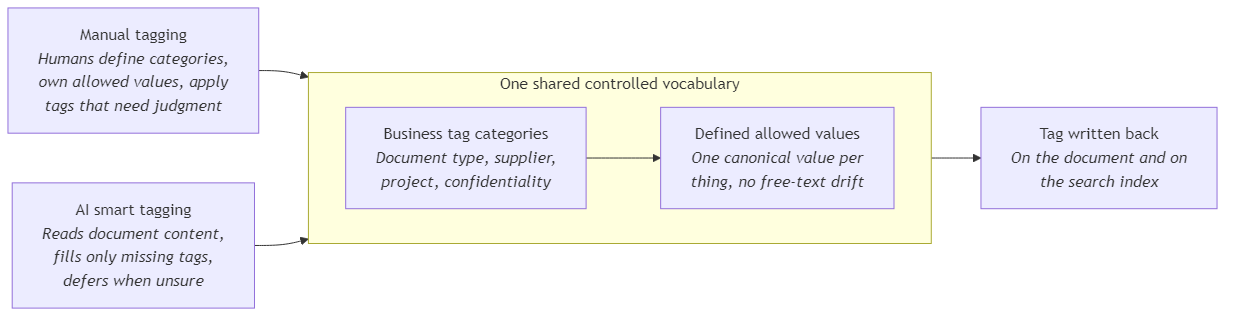
A classification system that holds up at scale rests on three things working together, with humans and AI each doing a defined part of the same job.
The first is a controlled vocabulary. Classification has to be organized into a set of categories the business uses (document type, supplier, client, project, confidentiality, and so on), where each category has a fixed list of allowed values. A controlled vocabulary is what turns Acme, Acme Corp, and ACME Ltd. into one canonical value that every filter, every search, and every report agrees on.
The second is a manual foundation. Humans define the categories, own the allowed values, and apply tags where judgment or accountability is required. Users need to set the first proper tags manually so the system establishes what “correct” means, giving the automated tagging that follows a stable vocabulary to extend.
The third is smart tagging, where an AI model reads a document’s content and assigns values that conform to the same vocabulary the humans defined. Done properly, the model chooses from the existing allowed values and applies the human-defined vocabulary across a far larger set of documents than any team could keep up with by hand, without inventing categories or coining new labels. The two paths converge on one shared vocabulary instead of running as two competing tagging systems.
Deciding what to tag by hand and what to automate
The question that decides outcomes is which document, which category, and whether a human or the model should apply the tag. A few rules of thumb hold up well in practice.
Documents that require highly-specialized tags, or a category where a wrong label carries legal or compliance consequences, is exactly where a human should stay in the loop and own the decision.
If the document types are consistent and a wrong tag would not carry legal, compliance, or heavy commercial consequences, smart tagging is useful for more than just cleaning up old documents. Running it across years of accumulated files nobody will tag by hand is the obvious starting point, but the same approach applies to newly arriving documents when the categories being filled in are low-stakes enough that verification is sufficient and a mistake is recoverable. Project or document-type labels might qualify; confidentiality level or legal hold status would not.
A well-built smart tagging step also knows its own limits, and three behaviors define whether it is safe to run at scale:
- It fills only the tags a document is missing, so a human-applied tag is never silently overwritten by a machine guess
- It chooses strictly from the allowed values already in use, so it extends the vocabulary without adding stray labels.
- When the content doesn’t clearly support any allowed value, it assigns nothing, which leaves the gap visible for a human to resolve instead of burying a wrong answer inside a confident-looking tag.
When a smart tagging run completes, the assigned tags are already written to the document and the search index (technical explanation in the search layer technical pair). The user is then notified which values the model inserted, with a prompt to verify them before relying on those labels in search or downstream workflows. The user can accept them as they stand or correct them manually, and the audit trail records whether each value came from a user or from AI.
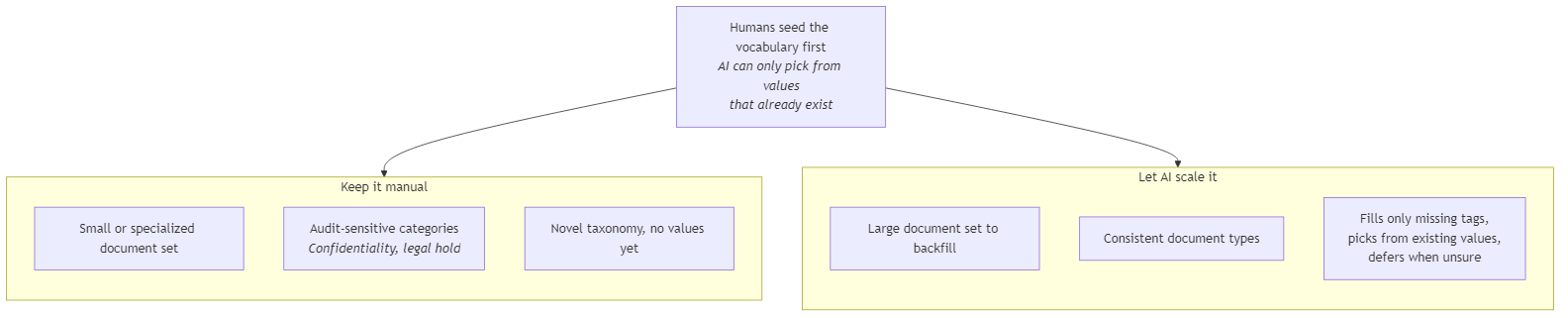
That last behavior points at the real dependency, in that AI classification can only ever choose from values that already exist, so the humans and the model do different jobs that depend on each other.
Reality check
Build the tags vocabulary. Smart tagging can only pick from tag values that already exist on other documents, so someone has to tag a representative sample by hand before the model has anything to choose from. The AI cannot invent the tagging structure and apply it reliably in one step. Well actually to be more precise, technically it could, but as explained earlier, in a real business environment it is wiser to leave that job to people.
Own and maintain the tags vocabulary. Deciding what categories exist, what the allowed values are, and when to add a new one, is a standing organizational responsibility. Without an owner the vocabulary drifts, new values creep in through the side door, and the system slides back toward the free-text chaos it was meant to replace. Without tag governance, search eventually becomes unreliable, because it can only filter documents as well as the tagging process allows.
Sensitive categories should stay human-controlled even after automation is working everywhere else. Confidentiality levels, legal hold status, and anything with a compliance consequence attached are places where “the model was fairly sure” isn’t a defensible answer, and keeping a person accountable for those tags is far cheaper than the incident that follows when nobody is. The audit trail records who applied each tag, when it was applied, and whether it came from a person or from AI. That record is what lets the organization explain later why a document was labeled the way it was.
None of this is free, and the honest framing is that classification is a recurring cost for as long as the document system runs. It is the cost that every downstream AI capability inherits, because a chat answer, an extraction, or a workflow can only ever be as well-scoped as the tags that filter the documents feeding it.
Conclusion
Classification is the discipline that decides whether the rest of the document system works. Teams that still treat it as a cleanup task keep deprioritizing the function the system depends on. The teams that get it right stop framing it as “tag the backlog this quarter” and start treating it as an ongoing operational responsibility, with an owner, a maintained vocabulary, and clear rules for what humans decide versus what the AI model fills in.
Manual and AI tagging are two parts of one system. Humans define and own the vocabulary and remain responsible for the categories that carry risk, while AI extends that vocabulary across stored documents at a scale no team can match. The combination is what turns a pile of stored files into a collection that can be filtered, searched, and acted on. Drop either half and you land back in one of the two failure states, just with better production values.
The technical pair for this piece is Building the classification and tagging layer.
Ideas, opinions, and tone are mine. AI helped with the language.
For more articles on AI-native document management visit the pialgorithms blog.
pialgorithms | document management software | ai engineering services