
Make AI answers auditable
A valid extract still isn’t enough if nobody can open the page and see where each field came from.
When the form is right and still useless
The extract finishes green. Every field clears the schema, the business validators pass, and the form looks ready for the ERP. Then someone from finance clicks a value, expects the source to open on the right clause, and gets nothing. The number sits there alone. So they download the PDF, search for “Net 30”, and spend the next ten minutes proving the system was right. Nothing in the model call failed. The verify step was never built.
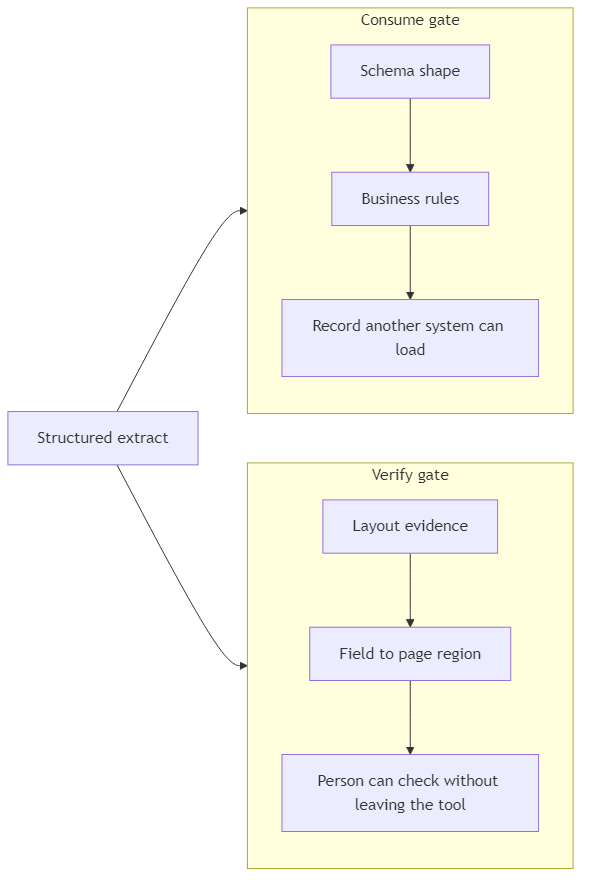
That gap is different from the one in mostly-right data extraction isn’t operational data. That pair asked whether another system can consume the record. This piece asks whether a person can check each field against the page without leaving the tool. Auditable answers are extracts you can prove at a glance, value next to the region it came from, not only JSON that happens to validate.
Where this sits after the consume gate
This series already argued that chat is not enough when the job is a process, that a workflow engine is a different machine from a chat service, that adding a document type should be configuration, and that operational data needs a declared shape and rules you can fail. Those pieces settle whether you extract, how you scale types, and whether the payload is fit to load.
This piece is the next bar. Once a record is shaped well enough to consume, the question that decides adoption is whether reviewers, auditors, and the people who own the process can verify each field against the source document in place. The architecture overview put extraction next to chat for a reason; chat already learned that a good answer carries citations you can open. Extraction needs the same instinct at field level, tied to layout, not only to a document title.
Where things go wrong
The common trap after you ship schema-first extraction is to treat a green, valid form as finished work. The model returned typed fields, validators cleared, Cosmos holds the request and response, and the team calls it auditable because the payload is explainable. Explainable isn’t the same as checkable. An auditor who asks “where on the page is that liability cap?” still has to hunt through a forty-page file by hand. You solved consume and left verify to the human.
The quieter version of the same trap is fake provenance. Someone stamps a page number that doesn’t match the clause, or paints a highlight over the whole page so every field “points” at everything. Reviewers learn quickly that the overlay can’t be trusted, so they stop using it and go back to the PDF. Theater that looks like auditability is worse than a blank form, because it teaches people to ignore the signal.
A third trap is confusing trails. Storing what the model was shown and what it returned is necessary when someone asks why a value was accepted or rejected three months later. That trail answers a different question from “show me the paragraph,” because one is process history and the other is visual location. You need both; neither replaces the other.
What auditable answers actually require
Auditable extraction is a short stack, and it sits on top of the consume gates from the previous pair without replacing them.
The first piece is a stable extracted record, the same shaped, rule-checked output you already decided was mandatory for operational use. Provenance without a stable field to attach it to is just pretty boxes on a page. If the value itself is soft, wrong, or unbound by schema, highlighting it only makes the mistake easier to see, which is useful in review and still not a finished extract.
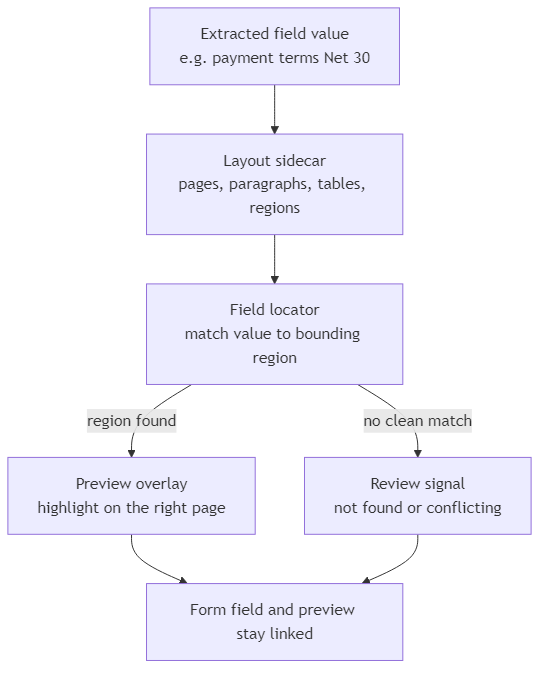
The second piece is layout evidence for the same document. At index time the platform already builds layout from the indexing pipeline and keeps it as a sidecar next to the document home. That layout is the map of pages, paragraphs, tables, and regions. Without it, field-level highlighting is guesswork. With it, each extracted value can be searched back into the map and tied to one or more bounding regions on the page.
The third piece is a verify-in-place UI. The form shows the field; the preview shows the highlight; hovering or selecting one lights the other. The reader never has to download the file to confirm “Net 30” lived in the payment-terms clause on page 12. If the locator finds nothing, or finds conflicting regions, the honest product behavior is to surface that as a review signal, not to invent a box.
An extract becomes auditable when those three pieces travel together. Valid JSON alone is consumable, layout alone is a map, and the UI alone is a viewer; together they turn “AI said so” into “see for yourself.”
How to decide what needs a location
This gives you a practical test for any field someone wants the engine to pull.
If a person will post the value, dispute it, or defend it in an audit, it needs a location whenever layout can supply one. Consume rules still decide whether the ERP can load it; the location decides whether the reviewer stops opening the PDF. If the field is only used for internal triage and never leaves the tool, a missing highlight is annoying and still not a blocker, and you can say so without pretending every key is sacred.
If layout was never stored for that document, you can’t retrofit trustworthy highlights later from the extract alone. The map has to exist before the locator can run. Teams that skip layout to save indexing cost discover the bill when finance asks for page proof and the product has none.
If the locator returns no region, or several that conflict, treat that as unfinished verify work, the same way a failed business rule is unfinished consume work. Painting a false highlight to keep the demo pretty trains users to ignore the overlay. Prefer an explicit “not found on page” state and a human check over a confident wrong box.
And keep the two gates separate in the product language. A record can clear schema and validators and still lack locations. A record can show clean highlights and still fail a cross-field rule. Calling either state “done” collapses the distinction this article exists to protect.
Reality check
None of this removes the ownership work from the previous pair. Someone still decides which fields count, what valid looks like, and which rules are hard stops. Provenance adds a second ownership question, which fields must be checkable in place before the process accepts them. Making that list longer than the consume list is how overlays become mandatory theater; making it empty is how you ship green forms nobody trusts.
Matching isn’t free. Layout extraction, storage, and the field-to-region search cost latency and money on top of the model call. Ambiguous strings, repeated totals, and dates written in three formats on the same page often won’t get a clean box. Budget for partial provenance and a review path, instead of promising every field lights up perfectly on every document.
Provenance also doesn’t replace validators. A highlighted wrong amount is still wrong, and easier to catch, which is the point of the overlay in review. The consume gate from schema-first extraction still decides whether another system should load the record. The verify gate decides whether a human will stop re-reading the source. You need both for extraction that survives contact with finance, legal, and audit.
And the overlay only works if people use it. If reviewers keep downloading the PDF out of habit, or if the highlight is too wide to mean anything, you’ve built a feature that looks good in a slide and changes no behavior. Design for one-click check, train for one-click check, and measure whether the second pass through the file actually drops.
Conclusion
Once you’ve left chat for extraction, the demo instinct after schema work is to celebrate any form that validates. That instinct is how teams ship consumable records that still force every careful user back into the PDF, and then wonder why adoption stalls after the pilot.
The platforms that get lasting value from extraction keep two definitions of done. Schema and rules decide whether another system can load the record. Layout-backed locations decide whether a person can prove each field against the page without leaving the tool. Auditable answers are what you have when both gates clear, or when a miss on either side is handled as unfinished work instead of a green badge.
The technical pair for this piece is Building layout-assisted field extraction.
Ideas, opinions, and tone are mine. AI helped with the language.
For more articles on AI-native document management visit the pialgorithms blog.
pialgorithms | document management software | ai engineering services