
Chat is not enough when the job is a process
A great chat reply still leaves the real work on your desk, and knowing where conversation stops is what separates a demo from a system.
The great answer that changes nothing
Your colleague asks the chat app a sharp question about a 40-page supplier contract, and thirty seconds later he has a clean, well-written answer with the right clause summarized. Genuinely useful. Then he opens that same contract, copies fifteen fields into the ERP by hand, checks each one twice, and files the result. The system answered his question and handed every bit of the actual work straight back to him.
That gap is easy to miss, because the answer felt like the whole job when it was really the first ten percent. The ninety percent that follows, pulling the fields out in a fixed shape, checking them, and putting them somewhere another system can use, is still sitting on his desk. A chat app is very good at the part that ends when someone finishes reading, and a lot of document work only starts there, which is the first sign that chat is not enough on its own.
Where this sits in the system
This series has spent nine articles building the conversational side of a document platform, from the architecture overview down to the search layer that finds the right passage and the grounded answer that cites its sources. Chat is the last stop on that road, and for a whole class of questions it’s the right destination. But conversation is only one of the two things people do with documents, and the chat app was never built to do the other.
Why chat is not enough on its own
The trouble starts when a team decides the chat box is the finish line and tries to run real processes through it. You can watch it happen. Someone types “extract the payment terms, the liability cap, and the renewal date from these three contracts and put them in a table”, copies the reply into a spreadsheet, and pastes from there into the system that actually needs the data. It works once, in a meeting, on three clean files.
Then it meets volume and consequence. The output is free text, so it comes back shaped a little differently every time, and nothing downstream can rely on it. There’s no validation, so a mis-read date or a currency that’s off by a factor of a thousand sails through looking exactly as confident as a correct value. There’s no record of how each number was produced, so when someone asks three months later why a figure is what it is, the honest answer is a shrug. A conversation is a fine way to understand a document, and a poor way to feed a system that expects the same structured, checkable result on every single run.
Answers and actions are two different jobs
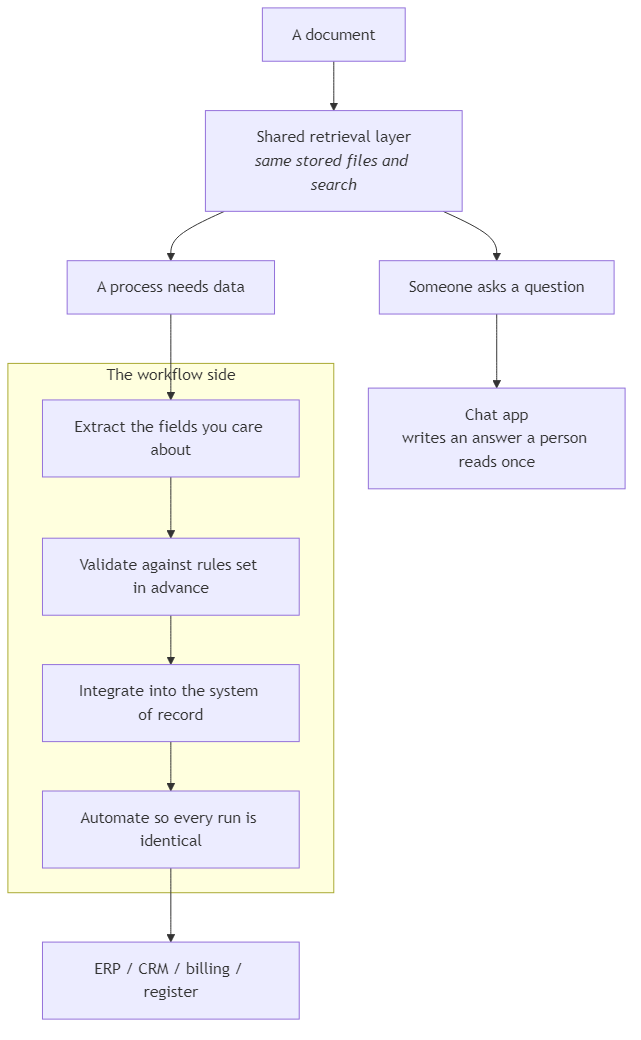
The split that clears this up is between an answer and an action. An answer is something a person reads once and acts on with their own judgment, and its job is done the moment they understand it. An action is a structured result another system consumes the same way every time, and its job is only done when the data lands somewhere and something happens because of it. Chat is built for the first, and the second needs a different machine.
That machine has a shape that keeps repeating across document work, whatever the document type. You extract the specific fields you care about, you validate them against rules you can state in advance, you integrate the clean result into the system of record, and you automate the whole path so the thousandth document runs exactly like the first. Extract, validate, integrate, automate. A chat reply gives you raw material for the first step and nothing for the three that carry the real operational weight.
How to tell which one you need
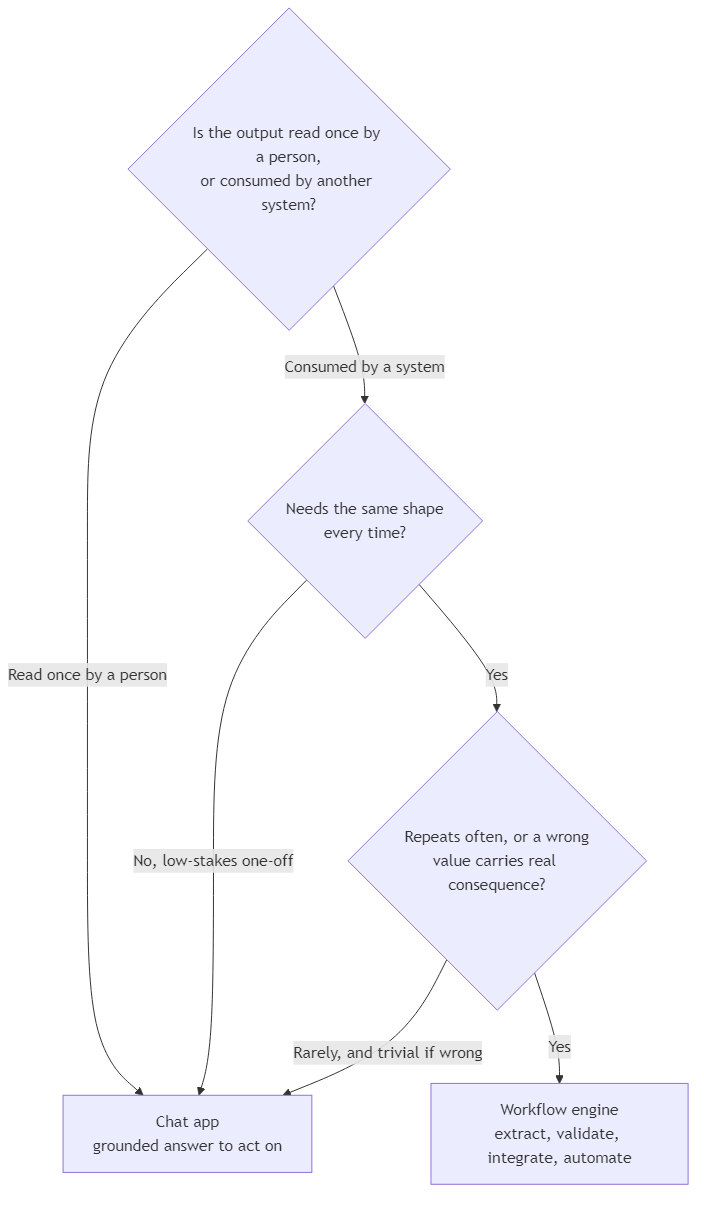
You don’t need a workflow engine for every question, and building one where a chat reply would do is how teams pay for machinery nobody uses. A few cues tell you which side of the line you’re on.
If the output is read once by a person who then decides what to do, chat is the right tool, and wrapping structure around it is wasted effort.
If the output feeds another system, an ERP, a CRM, a billing run, a compliance register, it has to come out in the same shape every time, and only a workflow gives you that. Free text that a human re-types is a workflow being run by hand.
If the same extraction happens over and over, on invoices every week or contracts every quarter, the repetition itself is the signal. Anything a person does the same way a hundred times is a process waiting to be defined once.
If a wrong value carries real consequence, a payment, a legal commitment, a regulatory filing, you need validation and an audit trail that a chat answer can’t give you, because “the model said so” doesn’t survive a dispute or an audit, while a validated field with a record of where it came from does.
Reality check
None of this makes the chat app disposable. The two paths share almost everything underneath, the same stored documents, the same search layer that finds the relevant passages, the same clean tags that let you filter to the right set. What changes is the contract at the very end, where chat returns prose for a human and the workflow returns validated data for a system. Building the second is real work, and it isn’t free, so it earns its place only where the volume, the repetition, or the consequence justify it.
It also needs an owner. A process that turns documents into operational data depends on someone deciding which fields count, what a valid value looks like, and where the result is allowed to land. That’s an organizational job, and no model setting decides it for you, so it’s the part most often skipped when a chat demo looks like it already solved the problem, when all that demo really solved was the reading, leaving the deciding, checking, and routing for later.
A chat demo is also a bad predictor of whether you have a working process. Impressing a room with one clean answer over three PDFs tells you nothing about whether the fiftieth invoice of the month lands in the ERP correctly with nobody watching it. The demo grades fluency, while the process is graded on whether the right data reliably ends up in the right place.
Conclusion
Chat feels like enough because it solves the part of document work you can see, the question and the reply, and quietly leaves the part you can’t, the structured result some other system is waiting for. Once you sort your document problems by whether you need an answer or an action, the split gets obvious, and so does the tooling each side calls for. Answers want a chat app that grounds what it says, and actions want a workflow that extracts, validates, and delivers data you can stand behind.
Most teams already have the first and assume it stretches to cover the second, when it doesn’t, and the tell is simple, in that if a person is reading a chat reply and re-typing it into another system, you’re looking at a process nobody has built yet, which is exactly the work worth doing.
The technical pair for this piece is How a document workflow engine differs from a chat service.
Ideas, opinions, and tone are mine. AI helped with the language.
For more articles on AI-native document management visit the pialgorithms blog.
pialgorithms | document management software | ai engineering services