
What a good AI answer actually looks like
Why grounding, citations, and agentic tool use separate a trustworthy answer from a fluent one
When fluent and wrong look identical
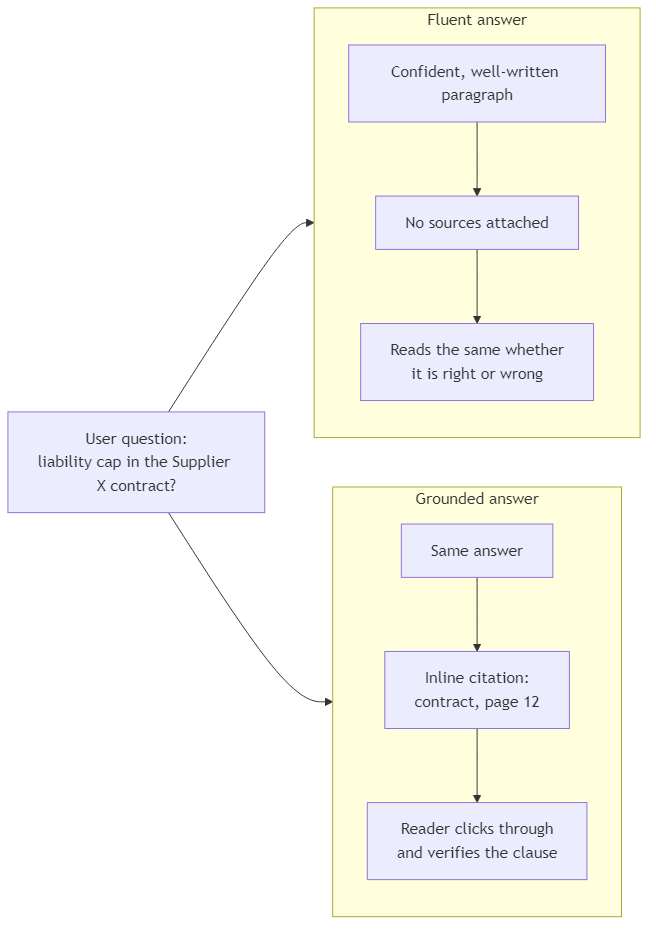
Imagine the CEO drops by with a simple question. “What does our contract with Supplier X say about the liability cap?”. Thirty seconds later the chatbot returns a clean, well-written paragraph with a specific number in it, and everyone nods. The number is wrong, the clause it came from was replaced by an amendment the model never retrieved, and nobody in the room can tell, because the answer reads exactly like a correct one.
That’s the failure mode that should worry you, precisely because it doesn’t look like a failure. Every current model is fluent, and fluency stopped being the hard part the moment these systems became usable. The hard part now is producing an answer someone can act on without quietly re-reading the source document to check it, which defeats the point of asking. A good AI answer has to clear a higher bar than sounding right.
Where the answer actually comes from
The chat box is the only part of the system most people ever see, but the answer it returns is the result of everything underneath it. It sits on top of the search layer that decides what can be found at all, which itself depends on the indexing pipeline that decided what was worth making searchable in the first place. This is where RAG either pays off or falls apart, because retrieval has to surface the right passages before the model writes a word. A good answer is the visible tip of that stack, and when the stack is solid the answer can do something a plain chatbot never can, which is back itself up with sources you can open.
Where things go wrong
The demo version of document chat is one prompt and one response. The user types a question, the system maybe runs a single search, hands whatever came back to the model, and returns whatever the model says. On a polished demo with three clean PDFs it looks magical, and on a real document collection it fails in ways that are hard to see.
It chokes on questions that have more than one part. “Compare the payment terms in our last three supplier contracts” is really three retrievals and a comparison, and a single-shot system answers it from whatever one search happened to surface, then writes a confident comparison across documents it never actually read together.
It guesses at arithmetic. Ask it to total the line items on an invoice or work out a pro-rated figure, and a language model produces a number that looks plausible and is often slightly wrong, because predicting the next token isn’t the same activity as calculating.
It breaks on the way real people type. A query with a typo, an ambiguous pronoun, or vague phrasing like “the Acme thing from last year” goes into the search engine as-is and pulls back whatever loosely matches the noise.
In every one of these cases the output is still fluent. There are no citations to check, no links to the page each claim came from, and no signal anywhere that the answer might be incomplete, so the reader is left trusting a paragraph that reads exactly as confidently when it’s wrong as when it’s right.
What a good AI answer looks like in practice
A trustworthy answer has three properties the demo version lacks, and they reinforce each other.
The first is grounding. Any fact the answer takes from a stored document must always carry an inline citation with a link that opens that document at the exact page where the fact appears. Naming the source in passing, or listing references at the end of the answer, still leaves the reader hunting for proof; the link belongs on the claim itself so verification takes one click. Grounding is what lets the CEO open page 12 of the right contract and read the liability clause themselves, using the same link that sits on the sentence she is checking. An answer without that link on every document-backed claim is an opinion with good grammar.
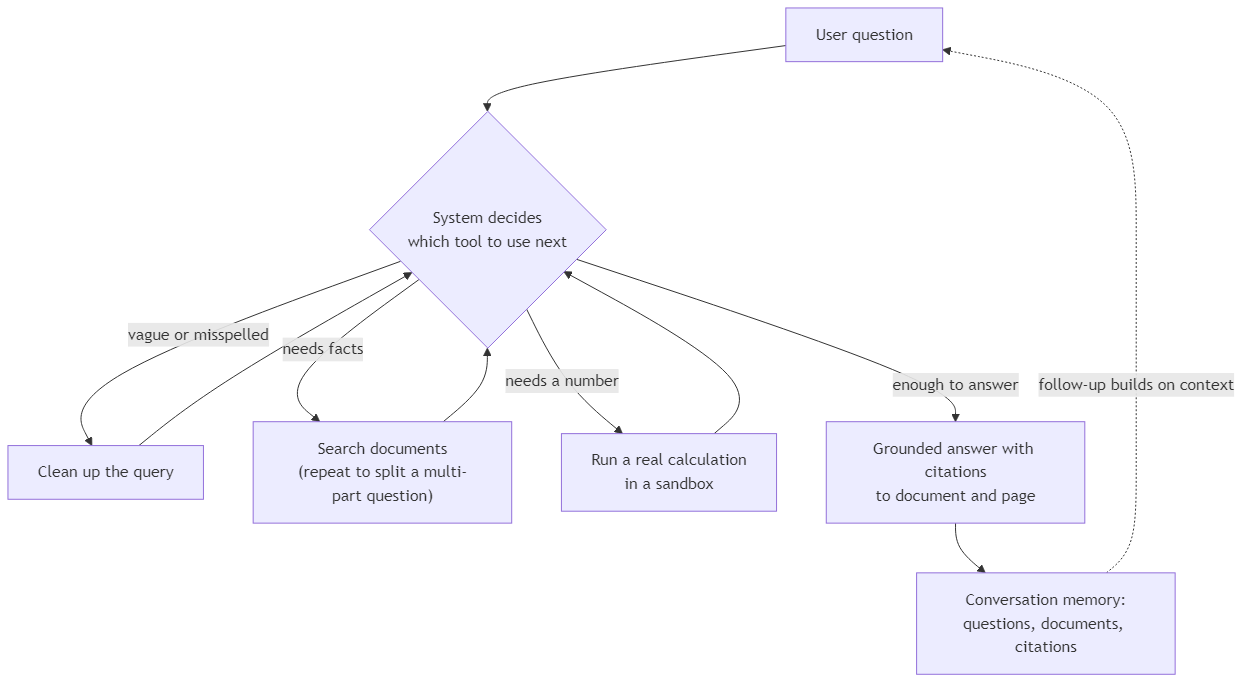
The second is agentic tool use. Instead of one automatic search, the system relies on tool calling, giving the model a small set of tools and letting it decide for itself how to use them to work the question. That’s what turns a one-shot RAG chatbot into an agentic one. It can clean up a vague or misspelled query before searching, so the search is aimed at the right thing. It can run the document search several times to break a multi-part question into separate lookups. It can hand any real calculation to a sandboxed code tool that computes the number instead of predicting it. The model chooses which tool to use, in what order, and how many times, and that’s what lets it handle a messy real question instead of only the clean ones.
The third is continuity. A real exchange is rarely one question. The user asks a follow-up, says “and what about the renewal clause?”, and expects the system to know which contract they are still talking about. A good answer carries the thread of the conversation, including the earlier questions, the documents already retrieved, and the citations already shown, so the next answer builds on the last instead of starting cold.
Underneath all three sits a quieter discipline, which is the willingness to say “I couldn’t find that in your documents” instead of manufacturing something. A system that grounds every claim can tell when it has nothing to ground a claim on, and saying so is often the most valuable answer it can give.
When you actually need this
Not every question needs this full setup, so the useful way to decide is by what the answer feeds into.
If the answer feeds into a legal, financial, or compliance decision, grounding and citations are non-negotiable, and every document-backed claim needs a link to the page it came from, because “the model said so” isn’t something anyone can defend in a contract dispute or an audit, while a number a person can open at the right page and read for themselves is.
If the questions are multi-step or involve numbers (comparisons across documents, totals, pro-rations, anything quantitative), the agentic tools are what separate a useful answer from a confident guess. A single-shot retrieval system will answer these questions; it just won’t answer them reliably.
If users hold real conversations with the system rather than firing one-off lookups, continuity is what keeps the experience connected, and without it every follow-up becomes a fresh start the user has to re-explain.
If the real use case is casual question-answering over a small, low-stakes set of documents where a wrong answer costs nothing and is easy to spot, a simpler setup is honestly fine. Not every problem needs an agent, and pretending otherwise is how you end up paying for capability nobody uses. The point is to match the cost of the answer to the consequence of getting it wrong.
Reality check
This costs more than a single model call, in two ways. An agentic answer can involve a query rewrite (fixing typos and vague phrasing before the AI search runs so the results match the question more accurately), several searches, a calculation, and the final composition, which is multiple back-and-forth steps where the demo version had one, so it’s slower and more expensive per question. That price buys answers you can check, and being able to check them is the whole value, but it’s a per-question cost you should budget for instead of pretending it doesn’t exist.
Citations are only as good as the layers beneath them. An answer can cite a page accurately only because the indexing pipeline preserved which page each chunk came from, and it can limit search to the right documents only because the tags and classification upstream are clean enough to filter on. Grounding is a property of the whole system, and a chat layer can’t add trust that the layers below it never made possible.
And grounding doesn’t make the answer correct, only checkable. If the source document is itself wrong, outdated, or replaced by an amendment that never got uploaded, the answer will still point to the wrong page correctly. What grounding guarantees is that a human can see exactly where a claim came from and judge it, which is a far stronger position than a fluent paragraph with nothing behind it.
Conclusion
Fluency is the cheap part now. Any model can produce a confident, well-written paragraph about your documents, and that paragraph is worth almost nothing on its own, because the reader has no way to tell a correct one from a convincing one. The thing worth building, and the thing worth paying for, is an answer that shows its sources, works the question with real tools instead of guessing, and remembers the conversation it belongs to.
A good AI answer is one you can act on without checking it yourself, and it earns that trust because you can check each claim, while polished wording adds nothing on its own. Teams that get this stop grading their AI on how it sounds and start grading it on whether someone can click through to the page a claim came from. That shift, from fluency to answers you can prove, is what separates a system people trust with real decisions from a demo that impresses once and gets quietly abandoned.
The technical pair for this piece is Building agentic RAG that grounds every answer.
Ideas, opinions, and tone are mine. AI helped with the language.
For more articles on AI-native document management visit the pialgorithms blog.
pialgorithms | document management software | ai engineering services