
Does your organization need a RAG chat app?
A practical framework to decide whether RAG actually makes sense for your organization
The RAG chat app
RAG (Retrieval-Augmented Generation) chat apps are becoming the default answer for anything related to document and AI these days.
If you’re reading this article, you most likely already know what it is. However, just for completeness, a RAG chat app is an application where users ask questions and get answers from an AI model based on the stored documents it has access to.
Now let’s get to the point.
Why everyone suddenly “needs” RAG
In practice, many organizations attempt to build or buy RAG chat apps before having an honest discussion internally on whether they actually need one. And the fair question here is, then why do they go for it?
Sometimes they are drowned in the FOMO of the AI hype.
Sometimes it’s about pushing the narrative of “we are using AI in our organization” as it sounds impressive externally.
Sometimes it’s simply because it sounds impressive internally to other teams: “look what we do in our department, and if you’re a good kid we might allow you to play with it”; typical short-sighted, can’t-see-the-forest-for-the-trees corporate power moves.
And unfortunately, more often than not, it’s one of these reasons. And that’s unfortunate, because when the main motivation behind implementing such project comes from these drivers, then the actual purpose (to serve the organization as a whole), tends to decay over time, as the implementation ends up being focused on the wrong goals.
Where things usually go wrong
A common pattern I see which explains this to some extent, is a combination of business users trying to solutionize, together with technical teams (usually from IT) that are either sidelined or unfamiliar with AI. So we suddenly baptized them “AI Applications Engineers” just because that’s the IT of the company, and why not? AI is IT, as fixing a printer is IT, as setting up channels on a TV is IT, duh?
Users know the business problems very well as they have become the bane of their existence. And here comes the most crucial part in the success of a technical project – the part where technical teams need to keep their ears wide open.
In the past, I believed that understanding the problem was 80% of the success, and the remaining 20% was the technical implementation, where my skills, and tbh mostly Stack Overflow, came in.
Today, my view is that understanding the problem has increased to 99% since code writing has been more or less solved by AI. And the funny part? Today’s AI is the worst it will ever be.
Having said that, most business users are (respectfully and justifiably) not very good at proposing technical solutions. And that is completely normal. It’s not their strongest suit, and it shouldn’t be (at the end of the day, they aren’t paid for that).
At the same time, if a recently named AI technical team is involved, then by definition they don’t yet have sufficient practical experience with AI systems. Now if both sides are overconfident, combined with the weak motives I mentioned earlier, things are very likely to go sideways quickly. Complexity gets underestimated, capabilities get overestimated, and what gets delivered is at best a glorified PoC that gets a standing ovation around a coffee table, but can’t even spell its own name when it presents itself in a crowded auditorium (that’s my artsy way of saying it can’t scale).
Before you adopt RAG, ask these
So yes, most organizations fall into this trap quite often. And to be fair, it’s understandable, we have all been completely RAG-washed.
So let’s try to bring some structure into this and make sense of the noise.
Before adopting a RAG chat app, ask yourself the following practical questions as they will help you determine whether you actually need it, and ultimately save you time, money, frustration, and eventually, your faith in AI:
1. Where is your bottleneck?
If the users’ main issue is:
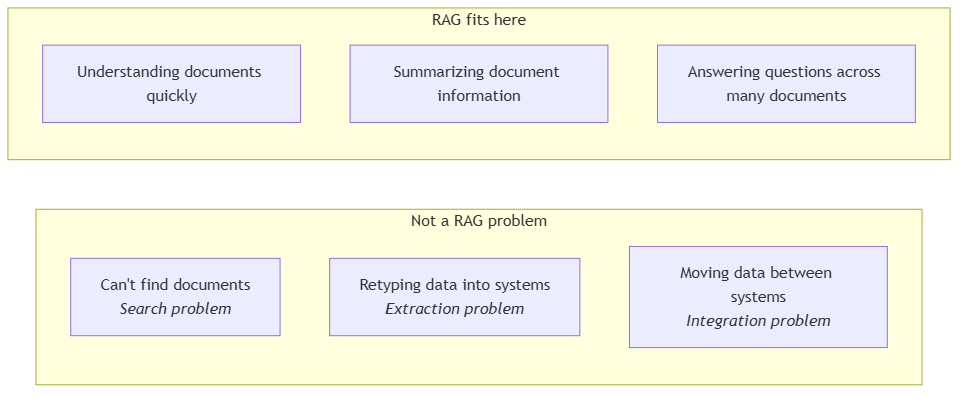
- Not being able to find documents (some in local folders, others in shared drives, many buried in emails – the classic Outlook Enterprise Vault torture, and a few in legacy systems that should have been eradicated along with the woolly mammoths) – this is a search problem
- Retyping data from documents into other systems… and then other systems… and then other systems – this is an extraction problem
- Moving data between systems – this is an integration problem
RAG is useful when the bottleneck is:
- Understanding documents quickly
- Summarizing document information
- Answering questions across many documents
If your problem is elsewhere, RAG won’t fix it.
2. What kind of documents are you dealing with?
Not all documents behave the same, nor they require same handling in a RAG system.
Broadly, there are two categories:
- Unstructured text documents (PDFs, emails, Word files, etc.)
- Structured or semi-structured data (Excel, CSV, tabular data)
RAG is primarily designed for unstructured text content such as contracts, reports, emails.
Audio and visual content (e.g. recordings, videos) can also be used, but only after they are converted into text (transcription, captions). At that point, they effectively become text, but with additional challenges, such as potentially poor transcription quality and loss of context (tone, visuals).
For structured data the requests are of different nature. Such could be filtering rows, applying calculations, or aggregating values. In these cases, a RAG system is usually the wrong tool. A simple Python script, SQL query, or BI (Business Intelligence) layer will be more accurate, cheaper, faster to build, faster to execute, and easier to maintain. Yes, you can push RAG further with tool calling (e.g. call code interpreter tool for calculations with Python), but at that point you are adding complexity to solve a problem that already has simpler and more reliable solutions, as mentioned before.
3. Do you need consistent outputs in a structured format?
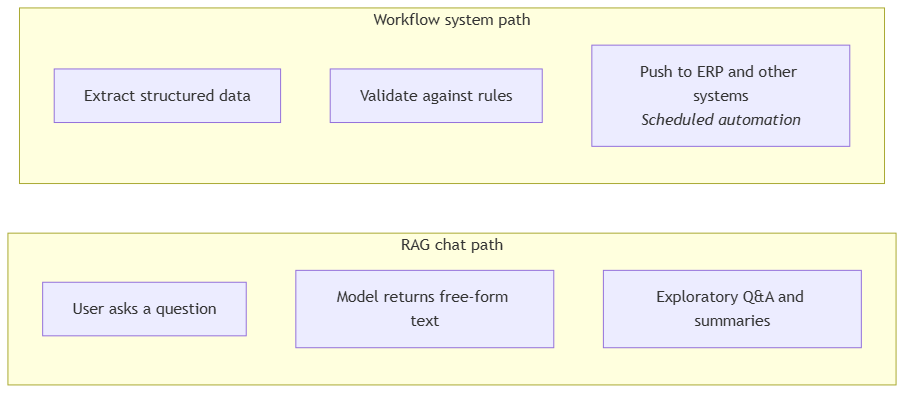
RAG systems are typically presented as chat interfaces. That means the language model generates free-form text responses, which are stochastic by nature, and as a result the same question can produce slightly different answers, phrasing may vary, structure isn’t guaranteed, and edge cases may behave inconsistently. And this isn’t a bug, it’s a feature.
For exploratory use cases such as asking questions, summarizing documents, and getting a quick understanding of a document, RAG is perfectly acceptable. However, in operational contexts, consistency matters more than flexibility. If users expect the same output with the same input, a fixed structure (specific fields, formats), predictable formatting, and overall deterministic behavior, then a chat-based RAG interface alone isn’t sufficient. With the introduction of tool calling, schema-constrained outputs, and post-processing layers you can get closer to structured outputs, however at this point you are no longer building a simple RAG chat, but a controlled workflow system that incorporates the retrieval of relevant content, constraining the model output, validating the results, and persisting structured data.
Long story short, if the business requirement is consistent answers and structure every time, then a RAG chat isn’t your solution.
4. Do you need answers, or actions?
RAG chat apps aren’t designed to generate and validate structured data consistently, update external systems, or perform actions outside the scope of the chat interface.
If users need to extract data from documents, send that data into ERP or other systems, approve documents, or trigger downstream processes, then what they actually need is a workflow system, not a chat interface alone. Because at that point, you are no longer dealing with a Q&A problem; you are dealing with a process. And processes require defined steps, validation logic, integrations with other systems and scheduled automations.
A chat can assist in this, but it can’t replace it.
5. And what happens after you get an answer?
This is where business comes in hot.
Your colleague logs in, takes a sip of his morning coffee, and starts playing around with the RAG chat, hoping AI will save him from the deadliest of all tasks: reading an entire document just to find the few data points he needs.
And the AI doesn’t disappoint. It gives him an answer that is (almost) there.
So his appetite grows, and now his thoughts start racing about how he can further automate his work. Meanwhile, you have barely had a few sips of matcha tea (trying to switch from coffee last couple of weeks after reading about its benefits) in your system, and the call comes in (you can already hear the excitement):
“Ok, I have a great idea. How can we send this data – but slightly transformed, to system X?”
“Can it trigger process Y after I have approved its reply?”
“Can it fetch data from A, B, C, combine them, and generate an Excel report?”
“Can it run all above every morning automagically?”
At that point, the real requirement becomes clear. What he actually wants is once again a structured extraction, validation, integration with other systems, a scheduled automation. In other words, the same request pattern repeating itself again and again.
6. Do you have the resources to support it?
Let’s assume you went though all the previous questions and a RAG chat app actually makes sense. Congratz! You have the right use case. And now comes the uncomfortable one:
Do you actually have the team and setup to build and support it properly?
There is something about people, I think, which is they tend to correlate how often they hear about something with how easy it is to build it. The more we hear and read about AI, the more it feels like any tech-savvy team (or even person) can just build it.
Sounds familiar? Everyone is an expert and has an opinion in social media. They wouldn’t sound that confident if they hadn’t built something, right?
And the cheap (if not free) access to powerful language models reinforces that feeling. It creates the illusion that we are much closer to building real AI systems than we actually are, otherwise they wouldn’t be accessible to anyone with a mobile phone or internet connection (and soon to any digital device, and locally).
But in reality, it doesn’t work like that.
Building and maintaining a functioning and scalable RAG system (which should be the minimum standard for any organization aiming for production-grade systems), requires people who understand AI and not just software development (although that definitely helps), understanding of retrieval, indexing, and evaluation, and the ability to design systems that behave reliable under real usage. This isn’t the same team that fixes printers, manages email distribution lists, or maintains legacy systems (said with the utmost respect to those roles).
And even when you have the right people, they need access to the right infrastructure and tools, proper permissions (which in large organizations can be a project on its own – grab a drink, light up a cigar, take a long drag), time to experiment, fail, and iterate.
And last but not least, there is the management layer. If leadership treats this as a side project, quick win, low hanging fruit (oh yeah, I can go on with corporate slang all day), then it will almost certainly remain a demo.
RAG systems require proper investment, clear ownership, and long-term support.
AI applications are a marathon, not a sprint. So before adopting one, ask yourself “Are we willing to support this properly?”. You got to either go all in, or don’t go at all.
Conclusion
RAG chat apps are powerful components for understanding and querying unstructured information from stored documents. But in most real-world cases, especially in large organizations, they are only one part of a broader system, and as such, if they are disconnected from everything else, they wither away over time.
So before adopting one, ask which problems you’re trying to solve and which system actually solves them.
Ideas, opinions, and tone are mine. AI helped with the language.
For more articles on AI-native document management visit the pialgorithms blog.
pialgorithms | document management software | ai engineering services